
Cloudflare down: the impact of a global outage on data sovereignty (and how to protect yourself from it)
Posted on
3/4/2026
par Seedext
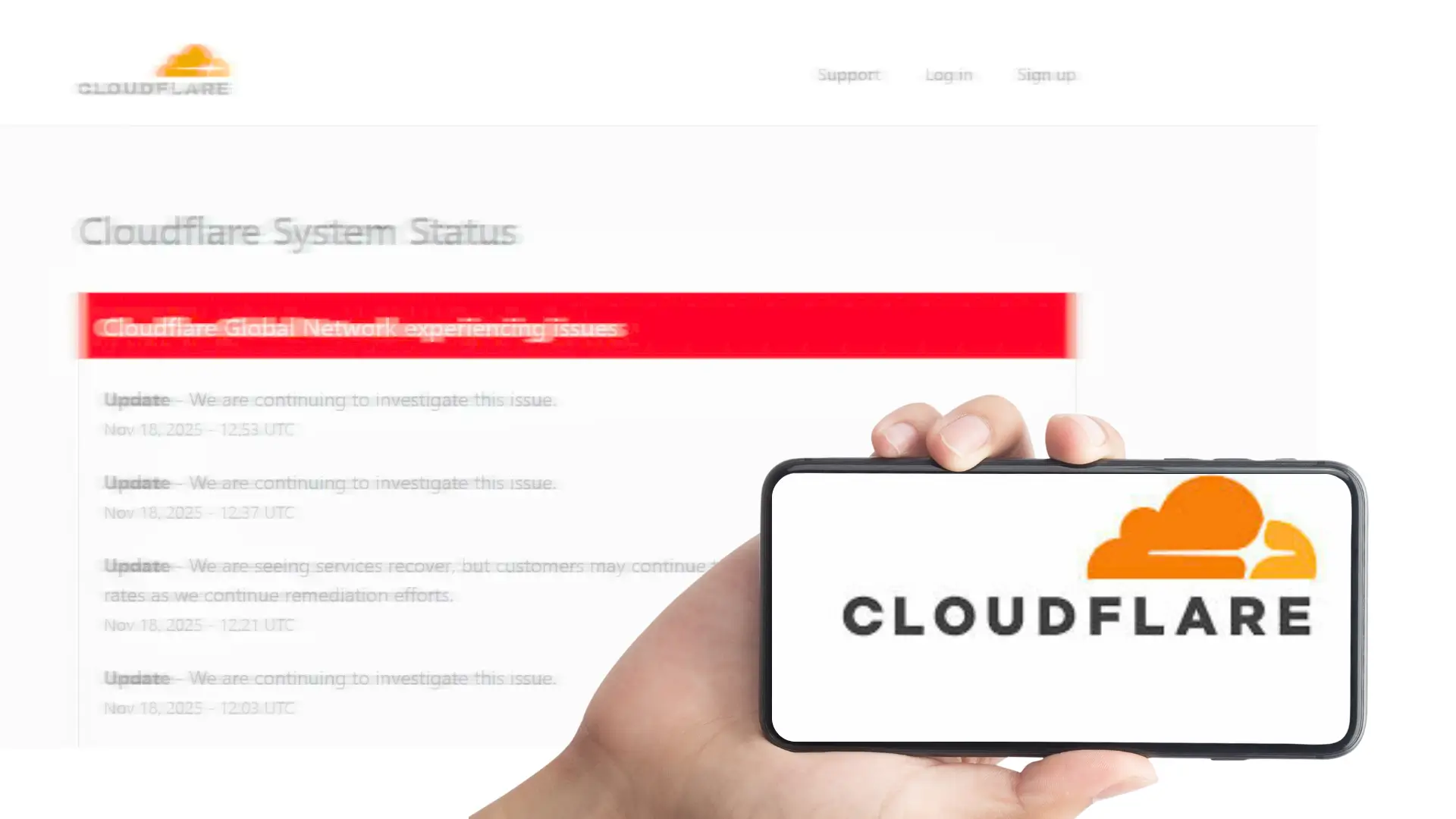
The global outage of Cloudflare, which occurred in a brutal and widely commented manner, left millions of users in the lurch. Canva inaccessible, ChatGPT refusing to load, X (Twitter) down, and a long list of services paralyzed without warning. Yes, all because of a single central infrastructure, saturated, frozen, unable to respond. A simple failure — yet isolated — was enough to create an unprecedented domino effect.
So what exactly does this reveal about how our data flows, is protected, hosted, and ultimately controlled? Why do we still depend, today, on a hyper-centralized model where an actor like Cloudflare Can a snap of your fingers (or an overheated server) disrupt a good portion of the Internet?
The outage Cloudflare is not a simple technical incident; it is a resounding alarm signal on the digital sovereignty, operational security and the resilience of modern services. And, spoiler alert: it is also an opportunity to explain why sovereign solutions like Seedext are becoming essential for reducing risks, protecting data, and maintaining reliable services despite the turbulence of the global cloud.
In this article, we dissect:
- Why the outage Cloudflare had such an impact
- What structural risks does it expose
- How this loss of control jeopardizes data sovereignty
- Why diversification and sovereign tools are now essential
- And how Seedext is part of a strategic response to the challenges revealed
Hang in there: what follows is a journey behind the scenes of an Internet that is more fragile than it seems.
Cloudflare: an essential giant... and a single point of failure
The place of Cloudflare in the global digital ecosystem is such that it is almost impossible to imagine the Internet without it. We are talking about a supplier who manages:
- 20% of global HTTP traffic
- millions of websites
- an army of CDNs, proxies, firewalls, network tunnels, anti-DDoS
- and a good part of the routing technologies used by businesses
In short, Cloudflare, it is the busiest highway on the web. But like any highway, when an accident blocks the way, nothing happens. And that is exactly what happened.
A centralized model that focuses risks
The problem is not so much the failure itself, but the structure of the system. If so many services depend directly on Cloudflare, it's because the ecosystem encourages centralization: performance, security, flexibility... of course. But at the price of sacrificed autonomy.
When Cloudflare Fall, everything falls.
Canva, ChatGPT, X/Twitter, Discord, Redbubble, Shopify, and dozens of other platforms have paid the price. Not because of internal failures, no: simply because their main protector, their gateway to users, their global proxy, was unavailable.
Businesses are paying a high price
The incident caused:
- loss of access for users
- millions of failed requests
- unexpected service interruptions
- the identification of structural weaknesses that many still refuse to see
And in a hyper-connected world, where every millisecond counts, dependence on a single actor like Cloudflare is a strategic risk that's hard to ignore any longer.
Cloudflare outage: a brutal indicator of the lack of digital sovereignty
The outage Cloudflare is not only a technical incident. This is a case study that illustrates one of the most profound problems of the modern Internet: strategic dependence on non-sovereign infrastructures, often based outside Europe, under extra-European jurisdictions, and completely out of local control.
Loss of control, loss of control
When a European company — SME, ETI, administration, or public platform — depends on Cloudflare, it depends on:
- servers not located in EU jurisdiction
- technical decisions based in San Francisco
- security policies defined by a private actor
- extraterritoriality risks (Cloud Act, FISA, etc.)
The result?
As soon as Cloudflare Encounters an anomaly, if one of its network nodes is overburdened or if a datacenter drops out, Europe suffers the consequences without being able to do anything.
The GDPR powerless in the face of infrastructure
What many forget is that data sovereignty is not only a question of legal compliance; it is also — and above all — a question of technical mastery.
If your data, transmissions, metadata, or logs go through Cloudflare, you are already in a model where:
- The EU has no direct control
- American authorities could require access
- the risks of escape or exposure increase
- GDPR guarantees are more theoretical than practical
The outage Cloudflare has simply revealed a known but often minimized reality: digital sovereignty is never a given when the infrastructure is not sovereign.
Cloudflare down: How global services were crippled
Like a house of cards, the most popular services fell one after the other, displaying Cloudflare errors, incomprehensible delays, or sudden blank pages. Let's talk about the most striking cases.
1. Canva unavailable
Unable to load a design, a template, or even the home page. Canva relies heavily on the CDN Cloudflare to distribute its front-end assets. In the midst of an outage, everything was blocked.
2. ChatGPT inaccessible
Again, some portions of traffic pass through external relays, including Cloudflare, especially to manage global routing. Result: 5xx serial errors.
3. X (Twitter) partially down
The social network has experienced interruptions in displaying timelines, publishing, and autoloading.
4. Multitudes of other paralyzed sites
According to DownDetector, the outage affected:
- creative platforms
- SaaS services
- API engines
- e-commerce sites
- marketing solutions
- and a long list of professional software
The conclusion? A failure Cloudflare is almost equivalent to an Internet outage — as the ecosystem relies on this single player.
Why the Cloudflare outage is changing the cloud and sovereignty debate
It would be wrong to reduce this incident to a one-time technical problem. The outage Cloudflare has opened a new chapter on three essential fronts: security, resilience and sovereignty.
Security: a minor incident can become a major crisis
With such a central player, a simple malfunction turns into a cascade of errors for the entire web. This model is no longer sustainable.
Resilience: addiction kills availability
A hyper-centralized infrastructure cannot guarantee total continuity. The single point of failure does exist.
Sovereignty: data control is not negotiable
It is impossible to claim digital sovereignty when flows, security and traffic pass through a foreign actor.
It is therefore necessary to rethink the way in which digital services are built.
How do you protect yourself from a Cloudflare outage? The winning strategies
To avoid experiencing the next outage Cloudflare, it is essential to diversify and rebuild a resilient architecture. Here are the major strategies.
1. Diversifying suppliers and avoiding lockdown
Never rely on a single supplier for:
- The CDN
- The DNS
- Routing
- The firewalls
- The tunnels
- Edge computing
2. Focus on sovereign solutions
European businesses need to start relying on locally anchored tools.
3. Minimize exposure to non-sovereign clouds
Limit critical flows that pass through American infrastructures.
4. Regain control of your data
Create hybrid models where part of the infrastructure remains strictly European.
Seedext: the very example of applied digital sovereignty
Unlike globalized juggernauts like Cloudflare, Seedext distinguishes itself by adopting a resolutely sovereign approach, centered on three pillars: security, autonomy and total compliance.
✔ A sovereign service, rooted in Europe
Data is processed locally, protected by European legislation, and never exposed to external jurisdictions.
✔ No dependence on foreign clouds
Unlike solutions like Canva, ChatGPT or X, Seedext is not impacted by outages Cloudflare thanks to an independent architecture designed to withstand disturbances.
✔ End-to-end security
Encryption, audits, strict control, total transparency.
✔ Availability designed without a single point of failure
Seedext is not subject to interruptions from American suppliers, which guarantees incomparable stability.
✔ An example for European businesses to follow
The outage Cloudflare has highlighted a fundamental principle: Sovereignty starts with the choice of its tools.
Seedext is the concrete demonstration of this.
The Cloudflare incident: a necessary shock
In reality, this type of outage is not a surprise. Experts in cybersecurity and cloud architecture have been saying it for years: dependence on American giants creates a fragile model where European companies are exposed to major risks.
The outage Cloudflare Put several essential questions back at the center of the table:
- How can availability be guaranteed if one depends on a single critical point?
- How to protect data confidentiality in an extra-European environment?
- How to ensure digital sovereignty when strategic flows pass through a non-sovereign supplier?
- Why are so many services still refusing to diversify their infrastructures?
These are all questions that deserve ambitious answers — and strategic decisions.
FAQ — Cloudflare outage, sovereignty & security
1. Why does a Cloudflare outage impact so many IT departments?
Because many platforms rely on the same shared IT infrastructures. When an incident affects Cloudflare's Information System, connected environments — sites, apps, cloud services — become unavailable, causing a global interruption.
2. What is the link between Cloudflare, Data Centers and Digital Sovereignty?
Cloudflare centralizes some of the traffic, processed in its global Data Centers and Datacenters. If your services rely on non-sovereign data centers, you lose control over data processing and compliance. Hence the interest of local and secure solutions.
3. How to reduce dependence on public cloud giants?
By adopting a private or hybrid cloud, by diversifying the host, by strengthening security, and by segmenting the Information System. This limits the risks associated with outsourcing and improves agility.
4. Does a Cloudflare outage increase cyber risks?
Yes, because incidents can temporarily weaken computer security or create windows of intrusion. Hence the importance of security solutions, automation, and continuous monitoring.
5. Why prioritize sovereign infrastructures?
To control where their data is hosted, limit dependence on global cloud services, and ensure compliance. Sovereign data centers ensure better connectivity, more predictable availability, and stronger security.
6. What role does virtualization play in resilience?
Virtualization makes it possible to quickly deploy dedicated environments, distribute loads, and avoid a point of failure. It is an essential foundation for any modern IT infrastructure.
7. How can businesses strengthen their digital posture?
By integrating digital transformation with security, automation and outsourcing practices, not to mention the use of sovereign software solutions.
8. Should big platforms like Canva or ChatGPT use multiple infrastructures?
Yes. Multi-infrastructure reduces the impact of an incident on a single public cloud and improves the continuity of their connected services.
9. How do you choose a really secure hosting provider?
Choose a sovereign hosting provider, with local datacenters, offering advanced security solutions, reliable connectivity and secure cloud services.
10. What sets Seedext apart?
Seedext relies on sovereign, secure environments, a local IT infrastructure and an outsourcing approach focused on protection, availability and confidentiality. It is the ideal alternative for hosting critical services with confidence.
11. Does deploying in a sovereign data center reduce the impact of a Cloudflare outage?
Yes, because a local and independent data center makes it possible to isolate critical applications and ensure total control over the deployment and distribution of traffic.
12. What role does cloud computing play in service continuity during global incidents?
Cloud computing offers flexibility, but in case of total dependency, an outage impacts all hosted services. Hence the importance of sovereign architectures.
13. Why is high availability essential to avoid the domino effect?
High availability distributes IT resources across multiple environments, limiting the risk of total outage when one of them falls.
14. How to successfully migrate to a sovereign Data Center?
Migration involves the analysis of applications, the definition of priorities, the synchronization of backups and a controlled interconnection strategy.
15. Are sovereign safeguards more reliable in the event of a global incident?
Yes. Local backups, hosted in an autonomous data center, allow for immediate recovery and protect data security.
16. How does past performance influence the resilience of services?
Sufficient bandwidth ensures smooth distribution of flows, even when global infrastructures and services are overloaded.
17. Why do some businesses prefer VMware or sovereign IaaS over AWS?
Because a local VMware or IaaS environment, hosted in France, has a controlled infrastructure, ensuring scalability, data security and regulatory compliance.
18. How can big data remain available if the global service is hosted through Cloudflare?
By hosting data in a hybrid cloud or sovereign data center, guaranteeing virtual resources independent of Cloudflare.
19. Can Ikoula or other sovereign hosting providers provide the necessary infrastructure?
Yes. A sovereign host provides the infrastructure, interconnection, supervision, and infrastructure services to host critical data and applications.
20. Why should companies outsource their hosted services to a Cloud in France?
Because a Cloud in France allows you to benefit from local infrastructures, strict access control, better supervision and reinforced security for data and virtual resources.
Conclusion: Cloudflare down, sovereignty up
The global outage Cloudflare This is not an isolated incident. It is the symptom of a model deeply weakened by hyper-centralization. The colossal impact on Canva, ChatGPT, X, and countless services is reminiscent of an emergency: Take back control.
Organizations need to rethink their infrastructures, diversify their dependencies and, above all, adopt sovereign solutions that can ensure continuity, security, and compliance.
That's where Seedext enter the scene.
Because a global outage should never become your local problem.
Because sovereignty is no longer a luxury: it's digital life insurance.
Because tomorrow, what will really matter is not raw power... but resilience.
What if the outage Cloudflare was it finally the lesson that Europe needed to get its digital destiny back in hand?